
The Business of Masculinity
Inside the manosphere, where frustration, misogyny, and self-improvement turn into engagement, visibility, and profit.
by Rossella Forlè, Founder We Hate Pink
In recent weeks, the manosphere has returned to the centre of public debate, partly following a new Louis Theroux documentary that explores some of the online communities often associated with what commentators call a “crisis of masculinity.”

Credit: Netflix
Rather than presenting it as a unified movement, the documentary highlights a more complex reality. The manosphere is not a single ideology or organisation, but a loose digital ecosystem of influencers, podcasters, streamers, and online entrepreneurs discussing masculinity, relationships, money, and power.
Within this space, very different figures coexist. Some position themselves as self-improvement coaches offering advice on dating, confidence and lifestyle. Others frame their content as cultural commentary on gender roles. And some operate more explicitly as digital entrepreneurs, transforming frustration and resentment into monetised content, paid communities and online businesses.
What connects these actors is less a formal structure than a shared narrative: the belief that men are losing status and influence in contemporary society, and that cultural, media or political systems are working against them. The simplicity and emotional charge of this story help explain why manosphere content travels so effectively across social platforms and algorithms.
Some of the most visible figures in this ecosystem include Andrew Tate, Myron Gaines, Sneako, Justin Waller and younger creators such as Harrison Sullivan.
They do not always share the same positions, and their audiences overlap only partially. But their content often follows a similar structure: masculinity is presented as something that can be optimised, monetised and scaled online.
Fitness regimes, dating strategies, investment advice, productivity routines and paid membership communities all revolve around the same promise: that men who feel disoriented in contemporary society can regain control of their lives.
The message resonates because it taps into a genuine sense of uncertainty many young men experience. At the same time, it reveals another aspect of the digital economy: masculinity itself has become a content format.
Attention as infrastructure
The dynamics of this ecosystem make much more sense when viewed through the lens of the attention economy. As media scholar Shoshana Zuboff argues in The Age of Surveillance Capitalism, digital platforms extract value from the real data generated by users. Every click, comment and share becomes part of a larger system designed to maximise engagement.
In this environment, visibility is not neutral. Content that provokes anger, conflict or outrage travels faster than content that encourages reflection. The manosphere operates extremely well within this structure.
Provocation drives engagement > Engagement drives reach > Reach drives revenue.
What appears as ideological extremism can also function as algorithmically efficient content.
Masculinity and digital labour
Economist Yanis Varoufakis describes today's platform economy as something closer to "technofeudalism” than traditional capitalism. In his analysis, platforms operate like digital territories where users produce value while the infrastructure owners capture most of the profit. Influencers are often portrayed as independent entrepreneurs who have escaped traditional work, but their reality is more like continuous digital labour.
The livestream never really stops; the content pipeline must stay active; the algorithm decides visibility. In this sense, the manosphere is not an alternative to the system; it is deeply embedded in it.
Misogyny as enforcement
Philosopher Kate Manne, in Down Girl: The Logic of Misogyny, argues that misogyny functions less as hatred and more as a social enforcement mechanism. It punishes women who are perceived to step outside traditional roles and rewards behaviour that reinforces gender hierarchies.
Seen through this lens, the manosphere is not simply a collection of offensive opinions; it is a system where gender hierarchies become performative content, dominance becomes spectacle, humiliation becomes entertainment, and misogyny becomes engagement.
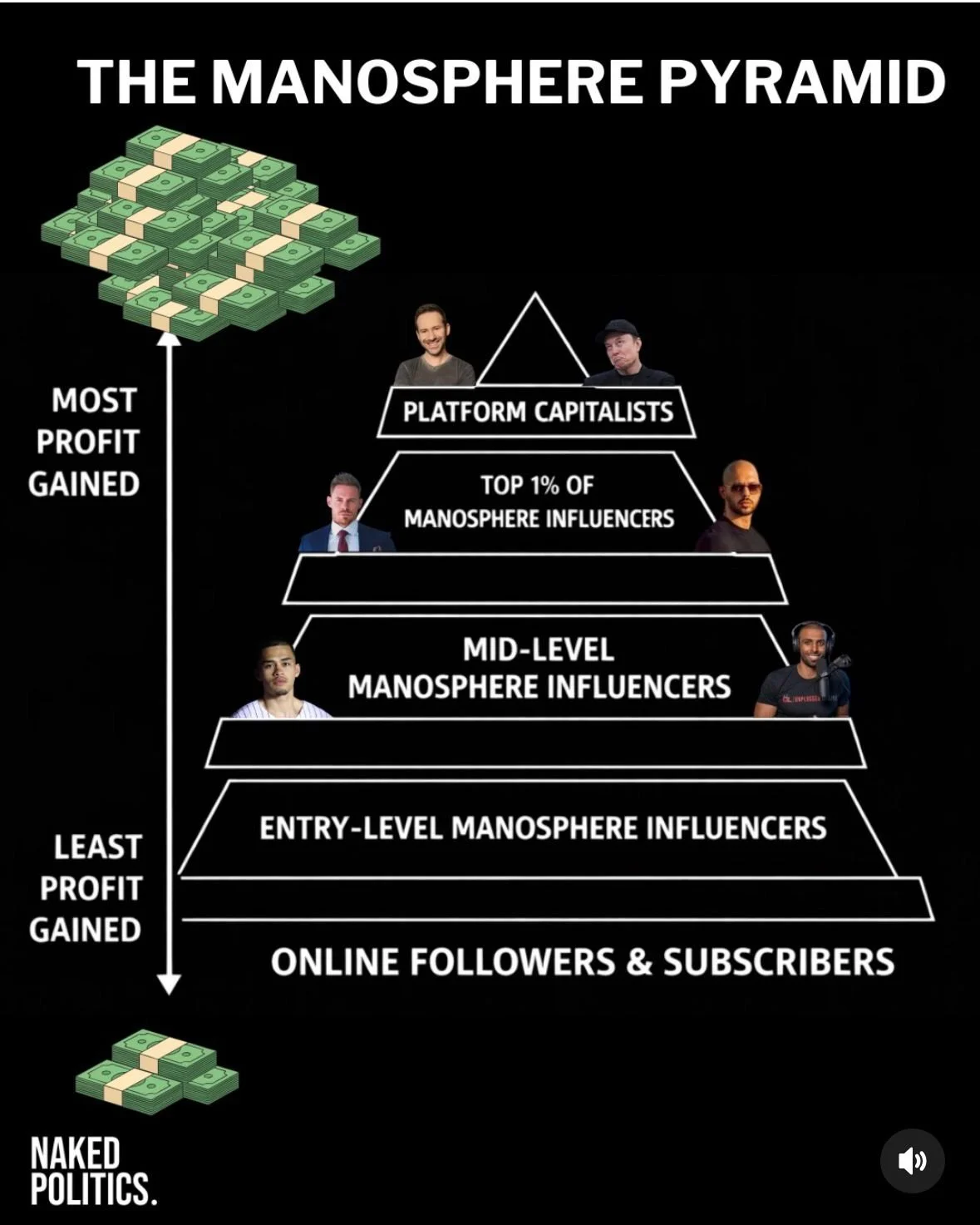
This is why reducing the manosphere to a few controversial personalities misses the point. The ecosystem exists because it fits perfectly within the economic incentives of digital platforms. Influencers produce content, audiences produce attention, and platforms capture the value.
The result is a feedback loop where the most extreme content often travels the furthest. The system doesn't require villains; it only requires engagement.
Blame is part of the product.
Another useful way to understand this ecosystem comes from research shared by The Otherbox, which looks at how online communities convert frustration into ideological pipelines. Underneath the luxury aesthetics and self-improvement language, the manosphere often sells blame.
Instead of framing personal struggles as structural, economic, or emotional, many influencers redirect their frustration toward identifiable enemies: feminists, queer people, immigrants, and “Wokeness.”
The narrative becomes deceptively simple: your problems are not systemic; someone took something from you, and someone owes you something.
This is a powerful psychological structure because it provides certainty in moments of confusion. It transforms complex social problems into a clear moral story: an in-group that deserves power and an out-group that supposedly stole it.
As The Otherbox points out, many of these communities tend to follow patterns that look surprisingly similar to cult-like dynamics. They often begin by offering certainty to people who are struggling or feeling lost, providing simple explanations for complex problems. Over time, a strong sense of belonging is built by defining a clear in-group — those who “understand the truth” — and an enemy responsible for everything that has gone wrong.
Loyalty to the community and its leaders is rewarded, while nuance, disagreement or critical thinking are often discouraged. And like many online ecosystems today, this sense of belonging doesn't stay purely ideological. It is gradually being turned into a product through paid memberships, courses, and exclusive communities that promise access, status, and answers.
In an attention economy driven by engagement metrics, this structure is extremely efficient. The more emotionally charged the narrative becomes, the more likely it is to spread. Outrage becomes visibility, visibility becomes influence, and influence becomes revenue.
The manosphere and the girlboss economy are mirrors

It is tempting to see the manosphere as the opposite of female empowerment culture. On one side, hypermasculinity; on the other, the language of empowerment and girlboss success. But if we step back for a moment, the structures start to look strangely similar. Both transform identity into a personal project that must be constantly optimised, both promise individual escape from structural problems, and both turn personal transformation into a market.
In the girlboss economy, the message was clear: confidence, productivity and ambition would allow women to break through the glass ceiling.
In the manosphere, the promise is different but structurally similar: discipline, wealth, and dominance will restore male power in a world that supposedly took it away.
Different aesthetic, same logic, where self-improvement becomes a business model. Courses, coaching programs, exclusive communities and digital content all follow the same script: if you follow the formula, you can become the next success story. What disappears from this narrative is something more complicated and much harder to monetise: structural change.
Both ecosystems thrive on the idea that social problems can be solved through personal optimisation.
Feeling excluded from economic opportunities? Build a personal brand.
Struggling with relationships? Follow the strategy.
Frustrated with the system? Outperform it.
These messages are powerful because they offer clarity in a confusing world. But they also shift the conversation away from larger questions about inequality, labour, economic precarity and social change. Instead of asking why the system produces so much insecurity, we are encouraged to become better competitors within it.
The real winners
The real winners are the digital platforms that thrive on the constant production of identity-based content. And the more emotional, aspirational or provocative that content becomes, the more engagement it generates. In digital media, engagement is the most valuable currency.
So while influencers compete for visibility and audiences search for answers, the infrastructure accumulates the real value.
If we look beyond individual personalities, it becomes clear that the manosphere is not an anomaly. It is simply another expression of the same economic logic that structures much of social media today.
Which raises an important question: why is the manosphere so popular, especially among young men? Part of the answer is that it speaks directly to a generation growing up in an increasingly precarious system.
Many young men find themselves in a context where the traditional promises of masculinity — economic stability, social recognition, the role of provider — have become far harder to achieve. Work is becoming more unstable, purchasing power is declining, and digital platforms are increasingly mediating social relationships.
In this environment, the manosphere offers something the economic system no longer provides: a simple narrative to explain discomfort and frustration. Instead of framing personal struggles as the result of broader economic or social transformations, frustration is often redirected toward identifiable targets.
This simplification is powerful because it turns complex problems into a clear moral story that can be easily shared online.
But there is another layer to this. As Mark Fisher writes in Capitalist Realism, contemporary capitalism is extremely effective at absorbing and monetising collective emotions — frustration, anger and anxiety — and transforming them into content.
Seen from this perspective, the manosphere is not only a cultural or political phenomenon, but it is also a model perfectly compatible with the economic architecture of digital platforms. And this is where the most uncomfortable point emerges. If frustration can constantly be turned into content, and content into profit, the system has no real incentive to address the conditions that produce it.
On the contrary, the more insecurity grows, the larger the market for those who claim to explain it becomes.
The manosphere, then, is not simply a cultural deviation; it is one of the most coherent products of the attention economy.